D'SKIN — Headless store, ordered by the routine
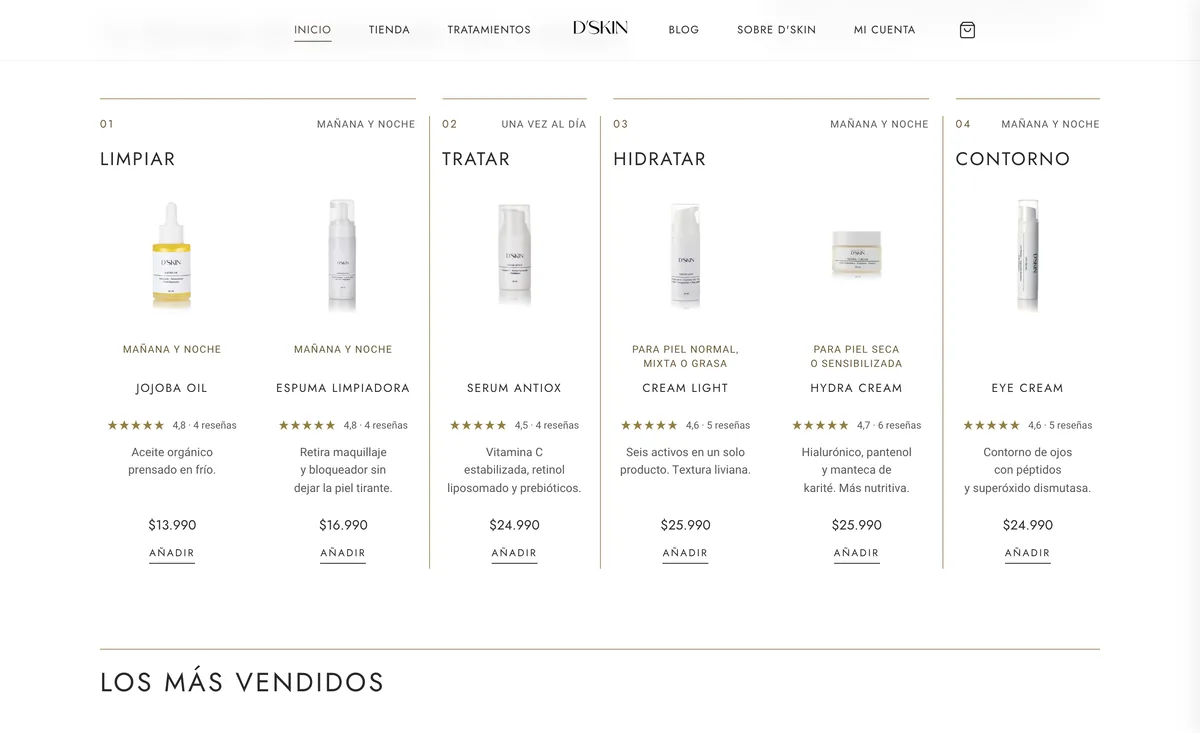
Full migration of a Chilean skincare brand's site from WordPress to Astro with headless WooCommerce. In 2026 the store was reordered end to end: you no longer browse by category, you browse by the four steps of the routine.
Visit live ↗- Astro
- TinaCMS
- React
- TypeScript
- WooCommerce API
- Supabase
- Full-Stack Developer
- November 2026
- Migration in December 2025 · redesign in November 2026
- D'SKIN
- Chile
- WordPress to Astro + TinaCMS migration with headless WooCommerce
- Own on-site checkout, in production since February 2026
- Store redesign ordered around the four steps of the routine
- Visual content editing for the marketing team
- Bilingual support (ES/EN) with full i18n
- Mobile Lighthouse: 99 performance, 100 accessibility, 100 SEO
The 2026 redesign: the store as a routine
A year after the migration the problem was no longer technical. The store was ordered by WooCommerce categories, and those categories were broken: “Beauty”, “Cream”, “Serum”, “Skin care”, and seven products sitting in “Uncategorized”. A customer arriving on the site does not know what a serum is. What she needs to know is that it comes second.
So the store was reordered around the four steps of the routine — cleanse, treat, hydrate, eye care — with every product under its step, its usage frequency and its skin type.
What changed the design was reading the orders. Grouping the 486 paid orders in the history by person — 196 customers — produced this:
- 42.9% arrive through the moisturiser, which is step 3. Only 6.1% arrive through step 1.
- 68.9% buy a single product on their first order.
- Of those who come back, 63.5% rebuy the same thing instead of moving along the routine.
Nobody had looked at this before, and it contradicted the obvious design. That is why the hero does not open on step 1 but on where people actually arrive, why the headline reads “you can start with one”, and why there is a block that asks what is already on your shelf instead of presenting the full routine as the only path.
Three decisions from the redesign
One source for the order, and nothing hand-written. A single file defines the four steps and which product sits in each. Price, photo and stock are requested from WooCommerce on every render. An out-of-stock product shows “Out of stock · notify me” and cannot be added to the cart, which is exactly what the previous store did allow.
Not a single @media. The whole redesign uses container queries, cqw units with clamp() and auto-fit grids. Every block behaves the same inside a column, inside a modal or at full page width, because it measures its container rather than the window.
The brand gold is not used as ink. #d8c7a5 measures 1.44:1 on a light background: as text it is illegible, as a rule it disappears. Labels use #6f5733, which gives 6.4:1 on bone, and rules use a mid tone. The brand colour stays where it works — in backgrounds and on product — not where contrast forbids it.
One mistake worth writing down
The scroll reveal on sections was set in CSS with opacity: 0. When the intersection observer does not get to run — and it happened in the mockup at 768 and at 390 — the page stays blank: the initial state applied and the final one never arrived. The hidden state is now set by JavaScript after mount, and only below the fold. With no JavaScript, or with prefers-reduced-motion, the page renders whole from the first paint.
The Challenge
D’SKIN, a Chilean natural cosmetics brand, had an existing WordPress + WooCommerce site that was showing its age. The client needed a faster, more modern web presence while retaining the ability to manage content easily and keep their e-commerce functionality intact.
The main goals were:
- Dramatically improve page speed and Core Web Vitals
- Provide a visual content editing experience for the marketing team
- Keep WooCommerce for product management and orders
- Support bilingual content (Spanish/English)
- Modern, premium aesthetic that reflects the brand’s natural skincare identity
The Solution
I architected a hybrid approach: Astro for the frontend with TinaCMS for visual content editing, while keeping WordPress + WooCommerce as a headless backend for product data and orders.
┌─────────────────┐   ┌──────────────┐   ┌─────────────────┐
│  Astro Site     │──▶│   TinaCMS    │──▶│  Static Build   │
│  (Frontend)     │   │  (Content)   │   │   (Hosting)     │
└─────────────────┘   └──────────────┘   └─────────────────┘
        │
        ▼
┌─────────────────┐
│   WordPress     │
│   WooCommerce   │
│   (Products)    │
└─────────────────┘
Key Features Implemented
Bilingual Support (ES/EN) — Full i18n implementation with Spanish as default, English routes at /en/* with complete translation, separate content collections per language (26+ blog posts each), localized UI elements, dates, currency formatting, navigation, and SEO meta tags per language.
Visual Content Management with TinaCMS — Real-time split-view preview editing, with editable sections and visual indicators: home page hero slider (4 configurable products), Best Sellers section with WooCommerce integration, About page with team gallery, treatment services catalog, and blog posts with rich-text editing.
E-commerce Integration — Product catalog fetched from the WooCommerce REST API in real time, client-side cart drawer with localStorage persistence, stock status and pricing synced automatically, and a fallback if the API does not answer. Checkout started as a cart hand-off to WooCommerce with a signed session; since February 2026 payment happens on the site itself, and WooCommerce stays as the catalogue and the order record.
Interactive Components — Cart drawer (380px sidebar desktop, full-width mobile), hero slider with configurable products, Google Reviews carousel, dynamic Instagram feed, WhatsApp floating button, and smooth scrolling with Lenis.
Performance Optimizations — Static site generation with Astro’s partial hydration, React components that only hydrate when needed (client:load, client:visible), and images optimized and served from an edge CDN.
Results
Measured in production with mobile Lighthouse, median of three runs:
- Performance 99, accessibility 100, SEO 100
- LCP 1.3 s and CLS 0.001
- Best practices 77, and it drops only because of third-party cookies from the advertising pixels: a brand decision, not a site one
The marketing team updates articles, treatments, product pages and page content with no technical help, and checkout has lived on the site itself since February 2026, with WooCommerce as the catalogue and the order record.
Technical Highlights
TinaCMS Visual Editing — Custom React wrappers enable real-time preview with the useTina() hook.
WooCommerce API Integration — Real-time product data with graceful fallbacks (getBestSellers(), getProductsByIds(), Chilean price formatting).
From hand-off to own checkout — The first version handed the cart to WooCommerce with a custom plugin and five-minute signed tokens, so the customer never retyped anything. It worked, but payment still happened on a site with a different design and a different domain. Since February 2026 checkout is just another route on the site: same design, same domain, and WooCommerce receives the order through the API.
This project demonstrates how a traditional WordPress site can be modernized with a headless architecture, combining the best of static site performance with the flexibility of a visual CMS and the robustness of WooCommerce for e-commerce.